
Writing About Your Photography
Writing about your work can feel like a challenge, but it’s an important part of presenting your photography. A well-crafted artist’s statement helps connect your audience to your creative process, giving them insight into your vision without over-explaining or limiting interpretation.
Your statement should be clear, concise, and engaging—usually one to two pages. It should introduce your work, explain your approach, and provide context while leaving room for the viewer to form their own perspective.
Here are some questions to help shape your writing:
- What inspired this project?
- How did the idea evolve, both creatively and technically?
- What obstacles did you face, and how did you work through them?
- What themes or ideas are you exploring?
- What do you hope people take away from your work?
If writing feels intimidating, keep it simple:
- Write how you naturally talk about your work—no need for pretentious “art-speak.”
- Outline your thoughts before you start writing.
- Get everything down first, then go back and refine.
- Use active voice and vivid descriptions to bring your work to life.
- Make sure each paragraph flows logically into the next.
- Have someone else read it to check for clarity.
A strong artist’s statement isn’t about proving anything—it’s about sharing your perspective. Approach it as part of your creative process, and let your passion for photography come through naturally.
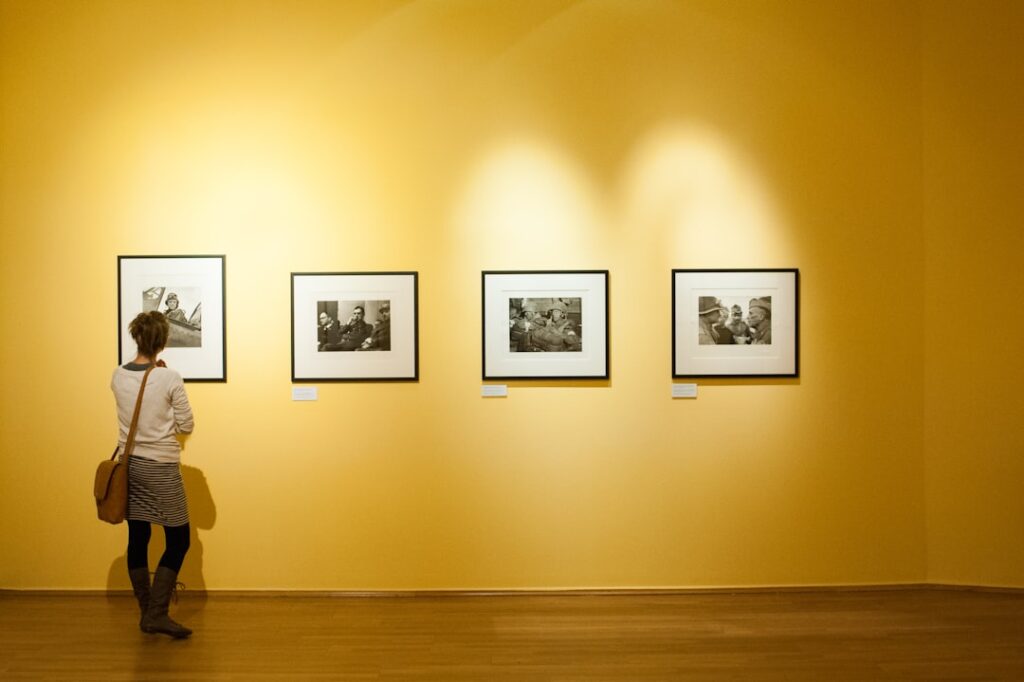
Here is an example:
Urban Rhythms: A Street Photography Series
Cities have a pulse—an unspoken rhythm shaped by movement, light, and fleeting moments. Urban Rhythms is a collection of street photography that captures the energy of everyday life, focusing on the intersections of solitude and connection in public spaces.
This series started with a simple curiosity: How do people exist within the chaos of a city? I was drawn to quiet moments—someone lost in thought at a bus stop, the way the late afternoon light stretches across a crosswalk or the brief eye contact between strangers. The contrast between stillness and motion became a recurring theme, shaping the way I composed each shot.
Photographing in these spaces comes with challenges—unpredictable subjects, shifting light, and the need to anticipate a scene before it unfolds. I worked with natural light and a fast shutter speed to freeze candid moments, using composition to guide the viewer’s eye through layers of the city.
At its core, Urban Rhythms is about observing the unnoticed. It’s about the way we navigate shared spaces, the emotions written on passing faces, and the small stories unfolding in the background of daily life. My goal isn’t to dictate a meaning but to invite the viewer to step into these scenes and find their own narrative within them.
Just like anything else you get better with experience, and practice. The more you write about your work, the easier it becomes. Over time, you’ll refine your voice, gain clarity on your creative process, and develop a stronger connection to your audience. Just like photography itself, writing is a skill that improves with practice—so start where you are, be honest in your approach, and let your passion come through.
Leave a Reply